
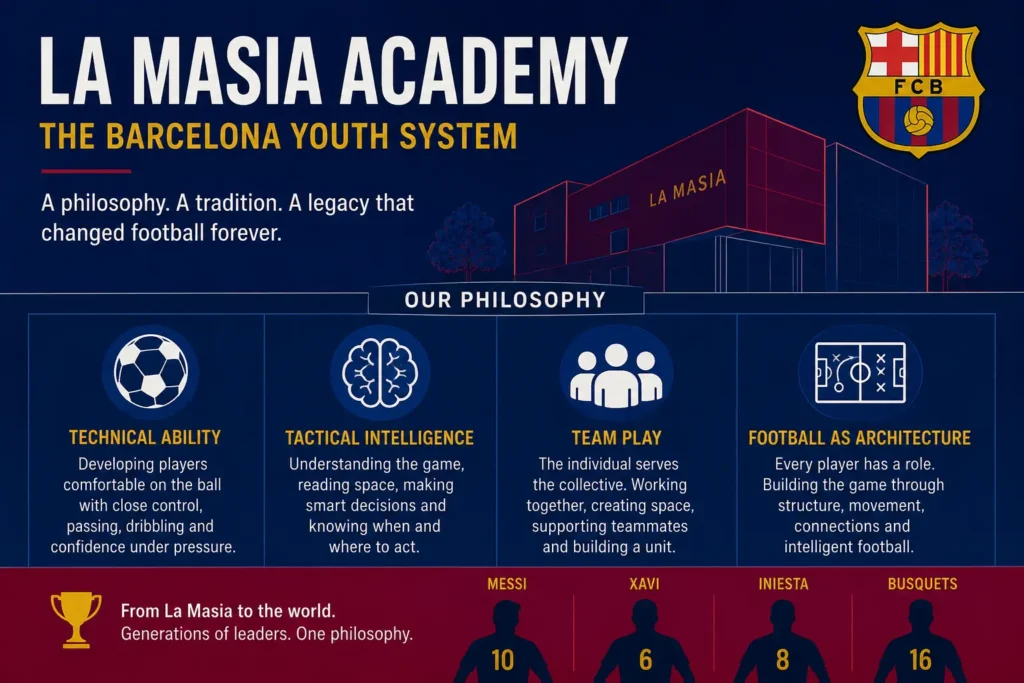
La Masia is more than a football academy that trains young players. It is a football education system built around a specific way of understanding the game. From their earliest stages of development, players are encouraged to improve their technical skills, understand space, make intelligent decisions, and play as part of a collective system.
This philosophy has become one of the defining characteristics of FC Barcelona. While many academies focus heavily on physical development, speed, strength, and individual performance, La Masia places a particularly strong emphasis on how players think and understand football.
The academy’s philosophy is built around several connected principles: technical ability, tactical intelligence, team play, positional understanding, creativity, and a deep understanding of the game’s structure.
Technical Ability: The Foundation of La Masia
Technical ability is one of the most important foundations of the La Masia system. Young players are encouraged to develop a close relationship with the ball from an early age.
A player must feel comfortable receiving the ball, controlling it, passing it, and protecting it under pressure. These skills become particularly important in Barcelona’s style of football, where players often receive the ball in crowded areas with opponents pressing aggressively.
The first touch is especially important. A good first touch allows a player to control the ball and prepare for the next action immediately. Instead of taking several touches to gain control, a technically developed player can receive the ball and already begin thinking about the next pass.
This creates a faster and more fluid style of football.
La Masia players are also encouraged to develop:
- Close ball control
- Short and long passing
- Dribbling in tight spaces
- First-touch ability
- Ball protection
- Body orientation
- Passing accuracy
- Ability to play under pressure
However, the goal is not to develop technical skills in isolation. A player is not considered technically excellent simply because they can perform tricks or dribble past opponents.
At La Masia, technique is connected to decision-making.
The important question is not only:
“Can the player control the ball?”
It is also:
“Can the player control the ball and immediately understand what to do next?”
This combination of technique and intelligence has been a major feature of many of the academy’s greatest graduates.
Tactical Intelligence: Learning to Read the Game
Football is a game of constant decisions. Players must understand where to move, when to pass, when to press, when to hold their position, and when to create space.
This is where tactical intelligence becomes important.
La Masia encourages players to understand football beyond their individual position. A midfielder should understand the movement of a forward. A defender should understand how to support the team’s build-up. An attacker should understand how their movement can create space for another player.
This creates players who understand the relationship between different positions.
For example, when a midfielder moves into a different area of the pitch, that movement can change the positioning of several other players. A teammate may need to provide support. Another player may move into the space that has been created.
The player is therefore not making decisions alone. Every decision is connected to the structure of the team.
This understanding is one of the reasons why the La Masia philosophy is often associated with positional football.
Players learn to consider:
- Where the ball is
- Where their teammates are
- Where the opponents are
- Where the available space is
- Where the next passing option may appear
This encourages players to think before they receive the ball.
The best players are often already aware of their next action before the ball reaches them. They have scanned the pitch, identified their options, and prepared themselves for the next decision.
That ability to think ahead can make a player appear faster than they actually are.
Team Play: The Individual Is Part of a Larger System
La Masia does not focus only on producing individual superstars. Its philosophy is based on the belief that football is ultimately a team sport.
A technically brilliant player can still struggle if they do not understand how to work with teammates. For this reason, players are taught to understand the importance of movement, passing options, positioning, and collective responsibility.
A player without the ball is still involved in the game.
A midfielder may move to create a passing option. A forward may make a run to pull a defender away. A defender may move into a better position to support the build-up.
These actions may not always appear in statistics, but they can completely change the way a team plays.
This is why Barcelona’s most successful teams have often been built around relationships between players rather than individual talent alone.
The understanding between players such as Xavi Hernández, Andrés Iniesta, Sergio Busquets, and Lionel Messi became so powerful because each player understood how to move, pass, create space, and support the others.
The result was a football style that often appeared effortless.
However, that fluidity was based on years of developing a shared understanding of the game.
Positional Understanding and the Importance of Space
One of the most important lessons associated with Barcelona’s football philosophy is the value of space.
Players are taught to understand that space can be created, occupied, or opened for another teammate.
For example, a forward may move away from the central area. This can force a defender to follow them and create space for a midfielder to attack.
A midfielder may move towards the ball, attracting an opponent and opening space somewhere else.
The player who eventually receives the ball may not always be the player who created the opportunity.
This is why football at its highest level is often about more than simply passing the ball to the closest teammate.
La Masia’s philosophy encourages players to understand:
- When to stay wide
- When to move inside
- When to create passing angles
- When to make a run
- When to move away from the ball
- When to occupy space
- When to create space for others
This type of understanding gives players greater tactical flexibility.
Instead of simply following instructions mechanically, they learn to interpret the situation on the pitch.
Decision-Making Under Pressure
Modern football gives players very little time to make decisions.
Opponents press aggressively. Passing lanes close quickly. A player may have only a few seconds to control the ball and decide what to do.
La Masia’s emphasis on technical ability and tactical awareness helps players deal with these situations.
A player must be able to:
- Scan the pitch before receiving the ball.
- Understand where pressure is coming from.
- Identify possible passing options.
- Control the ball in the correct direction.
- Make a quick decision.
This process happens repeatedly during a match.
The difference between a good player and an elite player is often not simply their physical ability. It is the speed and quality of their decisions.
This is one of the key ideas behind the La Masia model: the player should not wait until receiving the ball to begin thinking.
The best decision often begins before the ball arrives.
Creativity Within Structure
A common misunderstanding about tactical football is that structure limits creativity.
La Masia demonstrates a different approach.
The academy gives players a tactical framework, but that framework can create the conditions for creativity.
When a player understands where teammates are likely to be positioned, they can make more confident decisions. They know where passing options may appear and where space may develop.
This allows creativity to exist within a team structure.
A player can:
- Dribble past an opponent
- Attempt a difficult pass
- Change the direction of an attack
- Move into an unexpected position
- Create an individual moment of brilliance
But these actions become even more effective when the player understands the team’s overall structure.
This balance between discipline and creativity has been one of the most important characteristics of Barcelona’s football identity.
Football as a Collective Structure
The La Masia philosophy can also be understood as a connected structure.
Every player influences the players around them.
A defender’s positioning affects the midfield. A midfielder’s movement affects the attack. An attacker’s movement can create space for a teammate.
Football becomes a series of connections.
This is why the idea of an “architectural soul” fits the philosophy of La Masia. The team builds attacks through positioning, passing, movement, and relationships between players.
The ball moves through the structure.
Players create angles.
Space opens and closes.
The team constantly reorganises itself.
The best players understand not only where they are but also how their position affects the entire team.
This is one of the major differences between simply teaching football skills and developing a complete football intelligence.
Why This Philosophy Has Produced Elite Players
La Masia’s success comes from the combination of these principles.
A player may possess incredible technical ability. Another may have excellent tactical intelligence. A third may be physically gifted.
But the academy’s philosophy attempts to combine these qualities.
The ideal La Masia graduate is a player who can:
- Control the ball under pressure
- Understand the game
- Make fast decisions
- Recognise space
- Work with teammates
- Adapt to different situations
- Express individual creativity
- Understand the team’s tactical structure
This development model has helped produce players who could fit into Barcelona’s football identity while also becoming world-class footballers in their own right.
The academy’s greatest success is therefore not simply the number of famous players it has produced.
Its greatest achievement is the creation of a shared football language.
Players from different generations can understand similar principles because they have been developed within a similar football culture.
That shared language has helped connect different eras of Barcelona’s history.
The Philosophy That Connects Generations
From the golden generation of Lionel Messi, Xavi Hernández, Andrés Iniesta, and Sergio Busquets to the new generation represented by players such as Lamine Yamal and Gavi, the names may change, but the importance of football intelligence remains.
The players may have different personalities, physical qualities, and positions.
However, the core principles remain familiar:
Control the ball.
Understand space.
Think quickly.
Play for the team.
Make intelligent decisions.
This is the philosophy that has helped make La Masia one of the most influential youth development systems in football.
It is not simply a place where young players train.
It is a football culture.
And that culture has influenced FC Barcelona, its greatest teams, and football far beyond Catalonia.