
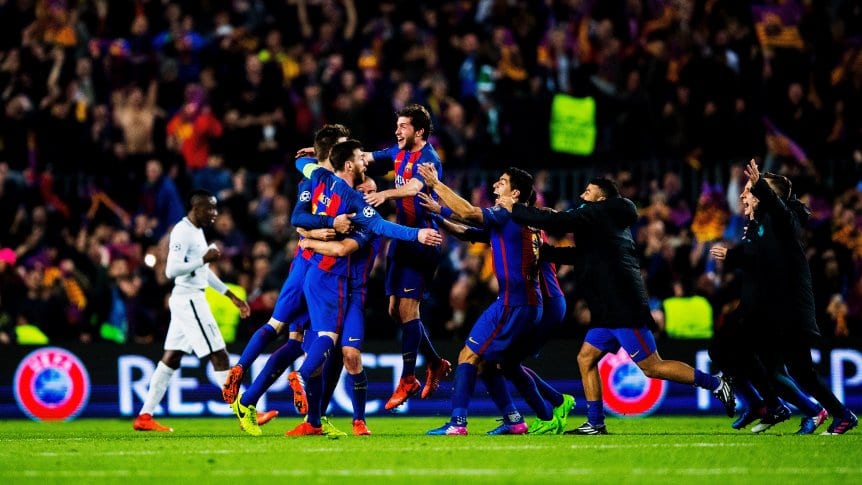
Barcelona 6–1 Paris Saint-Germain (2017): La Remontada
No discussion about Barcelona’s greatest comeback victories is complete without La Remontada. After suffering a 4–0 defeat in the first leg of the UEFA Champions League Round of 16 against Paris Saint-Germain, Barcelona faced what many considered an impossible challenge. No team had ever overturned a four-goal deficit in the Champions League knockout stage.
On 8 March 2017, Camp Nou witnessed one of the most extraordinary nights in football history. Barcelona raced into a 3–0 lead through goals from Luis Suárez, an own goal by Layvin Kurzawa, and a Lionel Messi penalty. However, Edinson Cavani’s away goal left Barcelona needing three more goals in the final minutes.
What followed became legendary. Neymar scored a stunning free-kick in the 88th minute before converting a penalty in added time. With just seconds remaining, Sergi Roberto met Neymar’s perfectly weighted cross to score the decisive sixth goal, completing an unforgettable 6–1 victory and a 6–5 aggregate triumph.
Why It Was Historic
- First team to overturn a four-goal first-leg deficit in the UEFA Champions League knockout stage.
- Camp Nou produced one of the greatest atmospheres in football history.
- Demonstrated Barcelona’s belief, resilience, and attacking philosophy.
- Sergi Roberto’s winning goal became one of the most iconic moments in club history.
Barcelona 5–4 Atlético Madrid (1997 Copa del Rey)
The 1996–97 Copa del Rey quarter-final remains one of Barcelona’s greatest domestic comebacks. After losing the first leg 2–2? Wait no—Barcelona entered the second leg needing a remarkable performance after trailing on aggregate, and Atlético Madrid quickly extended their advantage.
By halftime at Camp Nou, Barcelona found themselves 3–0 down on the night, leaving them with an enormous mountain to climb. Rather than surrender, the team responded with one of the finest attacking displays of the decade.
Ronaldo Nazário led the comeback with a sensational hat-trick, while Luís Figo and Juan Antonio Pizzi added crucial goals to complete an incredible 5–4 victory. Barcelona progressed after overturning what seemed an impossible situation and eventually lifted the Copa del Rey that season.
Why It Was Historic
- One of Barcelona’s greatest Copa del Rey comebacks.
- Ronaldo Nazário delivered one of the finest individual performances of his Barcelona career.
- Highlighted the club’s attacking identity during the late 1990s.
Barcelona 4–0 AC Milan (2013): Overturning a Two-Goal Deficit
After losing the first leg 2–0 at San Siro, many believed Barcelona’s Champions League campaign was over. AC Milan had defended brilliantly in Italy, and Barcelona needed a perfect performance at Camp Nou.
Lionel Messi ignited the comeback with two first-half goals, restoring belief across the stadium. David Villa added a third before Jordi Alba scored in stoppage time to seal a 4–0 victory and a 4–2 aggregate win.
Barcelona dominated possession, pressed aggressively, and produced one of their most complete European performances under coach Tito Vilanova’s staff.
Why It Was Historic
- Overturned a two-goal Champions League deficit against one of Europe’s strongest defensive teams.
- Lionel Messi produced a masterclass under immense pressure.
- Reaffirmed Barcelona’s reputation as a dominant European force.
Barcelona 3–2 Celta Vigo (2023): A Stunning Late Turnaround
Barcelona appeared destined for defeat after trailing Celta Vigo 2–0 entering the closing stages of the match. With little time remaining, the team mounted an incredible comeback that showcased its fighting spirit.
Robert Lewandowski started the revival before João Cancelo equalized. Just minutes later, Barcelona earned a penalty, and Lewandowski calmly converted to secure a dramatic 3–2 victory.
The comeback demonstrated that Barcelona’s resilience continues to define the club even in the modern era.
Why It Was Historic
- Three goals scored in the final stages of the match.
- Highlighted the leadership of experienced players.
- Reinforced Barcelona’s never-give-up mentality.
Barcelona 5–4 Benfica (2025): A Modern European Comeback
Barcelona produced another memorable Champions League comeback against Benfica during the 2024–25 season. Trailing for much of the contest, the team continued attacking with intensity and belief.
Goals from the attacking unit, combined with relentless pressure, turned the match around in spectacular fashion. The victory demonstrated the emergence of Barcelona’s new generation while maintaining the club’s historic attacking philosophy.
Why It Was Historic
- One of Barcelona’s most exciting European matches in recent years.
- Showcased the quality of the club’s young talent.
- Reflected the team’s ability to fight until the final whistle.
Barcelona 3–2 Paris Saint-Germain (1995)
Before the famous 2017 comeback, Barcelona had already produced memorable European nights against Paris Saint-Germain.
In the 1994–95 UEFA Cup Winners’ Cup quarter-finals, Barcelona recovered from difficult moments to secure a hard-fought victory over the French club. The match highlighted the team’s determination and laid the foundation for future European successes.
Why It Was Historic
- Important European victory during the 1990s.
- Demonstrated Barcelona’s resilience in continental competition.
- Strengthened the club’s growing reputation in Europe.
Barcelona 4–3 Real Sociedad (1998)
Barcelona’s thrilling victory over Real Sociedad remains one of the club’s most entertaining league comebacks.
After falling behind, Barcelona responded with relentless attacking football, creating chance after chance before eventually completing a dramatic 4–3 victory. The match perfectly reflected the club’s commitment to entertaining, offensive football.
Why It Was Historic
- Seven-goal thriller in La Liga.
- Showcased Barcelona’s attacking philosophy.
- Another example of the team’s refusal to accept defeat.
Key Contributors Behind Barcelona’s Greatest Comeback Victories
This section will cover the influence of Lionel Messi, Neymar, Sergi Roberto, Luis Suárez, Ronaldinho, Andrés Iniesta, Xavi Hernández, and Pedri, explaining how each helped shape Barcelona’s comeback legacy.