
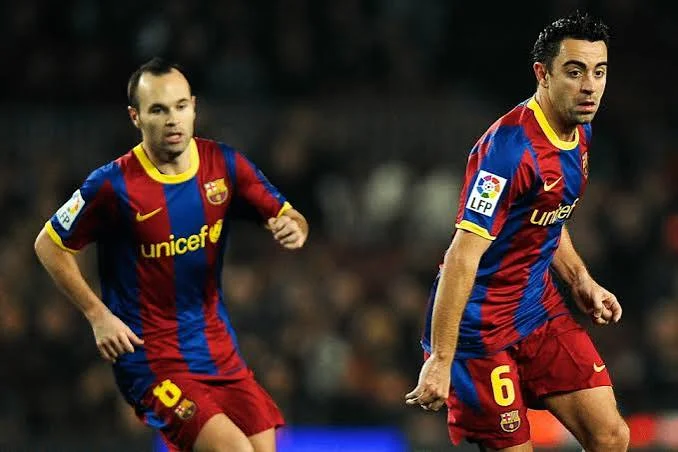
Xavi controlled the rhythm. Iniesta created the magic. But when it comes to Barcelona’s midfield, who was truly better?
Xavi Hernández and Andrés Iniesta are widely considered the two greatest midfielders in FC Barcelona’s history, and for over a decade they played side by side, forming the engine room of the most dominant club side football has ever seen. What makes comparing them so difficult is that they rarely competed for the same job. Xavi dictated tempo from deep, while Iniesta operated as the creative spark who broke lines and produced decisive moments. Different tools, same team, same trophy cabinet.
This article compares Xavi and Iniesta’s Barcelona careers across stats, trophies, playing style, creativity, big-game impact, and long-term legacy, to help settle one of the most debated questions in Barcelona history: who was the better midfielder?
Xavi vs Iniesta: Quick Comparison
| Category | Xavi | Iniesta |
| Position | Deep-lying playmaker | Central/attacking midfielder |
| Barcelona Career | 1998–2015 (17 seasons) | 2002–2018 (16 seasons) |
| Appearances | 767 | 674 |
| Goals | 85 | 57 |
| Major Trophies | 32 (8 La Liga, 4 Champions League) | 32 (9 La Liga, 4 Champions League) |
| Playing Style | Passing, vision, tempo control | Dribbling, creativity, ball progression |
| Key Strength | Game control and possession | Escaping pressure and decisive moments |
| International Honours | World Cup 2010, Euro 2008, Euro 2012 | World Cup 2010, Euro 2008, Euro 2012 |
The trophy counts are almost identical a reflection of just how many years they spent winning together in the same Barcelona midfield. The real differences show up in how they won those trophies, not how many.
Xavi’s Barcelona Career
Xavi’s Rise at Barcelona
Xavi joined La Masia at age 11 and made his first-team debut in 1998 under Louis van Gaal, scoring on his debut in the Spanish Super Cup. He developed into Barcelona’s first-choice deep-lying midfielder years before the club’s most successful era began, giving him a foundational role in shaping the team’s possession-based identity.
Xavi’s Playing Style
Xavi’s game was built almost entirely on passing and vision. He rarely dribbled past opponents or covered large distances at speed; instead, he controlled matches through positioning, quick one- and two-touch passing, and an almost instinctive sense of when to speed up or slow down the tempo of a game.
Xavi’s Greatest Achievements at Barcelona
Across 17 seasons, Xavi won 32 trophies with Barcelona, including eight La Liga titles and four UEFA Champions League titles, making him one of the most decorated players in the club’s history.
Xavi’s Influence on Barcelona
Xavi is widely credited as the architect of Barcelona’s tiki-taka era. His ability to retain possession under pressure and dictate the pace of a match became the foundation of the club’s dominant style under Pep Guardiola, and his influence carried through to his later career as Barcelona’s head coach.
Iniesta’s Barcelona Career
Iniesta’s Journey at Barcelona
Iniesta arrived at La Masia at 12 years old and made his first-team debut in 2002, but it was under Frank Rijkaard from 2004 onward that he became a regular starter. His rise coincided with Ronaldinho’s peak years at the club, and he gradually evolved into one of Barcelona’s most important attacking midfielders.
Iniesta’s Playing Style
Iniesta’s game was defined by close control, low-center-of-gravity dribbling, and an almost uncanny ability to escape pressure in tight spaces. Where Xavi moved the ball to control a game, Iniesta moved with the ball to break through defensive lines.
Iniesta’s Greatest Achievements at Barcelona
Iniesta won 32 trophies during his 16 seasons at Barcelona, including nine La Liga titles and four Champions League titles, and remains one of the most decorated players in the club’s history.
Iniesta’s Influence on Barcelona
Iniesta’s technical brilliance complemented Xavi’s control perfectly. While Xavi kept the team ticking over, Iniesta provided the moments of individual quality that unlocked matches most famously his extra-time winner in the 2009 Champions League semi-final and his World Cup-winning goal for Spain in 2010.
Xavi vs Iniesta: Playing Style Comparison
Who Was the Better Passer?
Xavi has the stronger case here. His short-passing accuracy, range, and ability to set the tempo of a match were unmatched among his teammates, and it’s the primary reason he’s remembered as Barcelona’s midfield conductor.
Who Was the Better Dribbler?
Iniesta has the clear advantage. His close control and ability to glide past opponents in tight spaces, particularly in central areas, made him one of the most difficult players in the world to dispossess.
Who Was More Creative?
This is closer, but Iniesta generally gets the nod for final-third creativity. His ability to find pockets of space between defensive lines and produce decisive passes or dribbles in high-pressure moments gave Barcelona an attacking dimension that pure passing alone couldn’t provide.
Who Had Better Game Control?
Xavi’s ability to control the rhythm of a match through positioning and possession was arguably his greatest quality. Guardiola’s Barcelona was built to funnel play through Xavi, and few midfielders in history have matched his influence over the flow of a game.
Xavi vs Iniesta: Stats Comparison
Xavi’s 767 appearances and 85 goals need to be read in the context of his role as a deep-lying playmaker rather than a goal scorer; his value showed up in passing volume and accuracy, not the scoresheet. Iniesta’s 674 appearances and 57 goals reflect a more advanced role, with a higher proportion of his output coming in decisive, high-leverage moments rather than consistent week-to-week output.
Their trophy hauls are almost a mirror image of each other 32 each which underlines just how many of Barcelona’s greatest seasons they won together rather than separately.
Who Was More Important to Barcelona’s Greatest Teams?
During the Pep Guardiola era, Barcelona’s possession-based football depended on a midfield triangle: Xavi controlling and distributing, Sergio Busquets shielding the defense and recycling possession, and Iniesta driving forward to create. Removing any one of the three would have fundamentally changed how that team played.
Xavi, Iniesta and Busquets
This trio is often considered the greatest midfield partnership in football history. Xavi provided control and distribution, Busquets offered defensive intelligence and calm buildup play, and Iniesta supplied creativity and ball progression. Their chemistry, built over years playing together from Barcelona’s youth ranks, was arguably as important to Barcelona’s success as any individual within it.
Xavi vs Iniesta in Big Games
Both players delivered in Barcelona’s biggest moments. Xavi was named Man of the Match in the 2009 and 2011 Champions League finals, and he was central to Spain’s Euro 2008 and Euro 2012 triumphs. Iniesta, meanwhile, is remembered for a string of decisive individual moments, most notably his last-minute goal against Chelsea in the 2009 Champions League semi-final and his extra-time winner in the 2010 World Cup final for Spain.
Xavi’s big-game impact tended to come through sustained control across 90 minutes, while Iniesta’s came through singular moments that decided matches outright.
Xavi vs Iniesta: Who Was More Consistent?
Xavi’s longevity and positional reliability give him an edge here. He was rarely injured for extended periods and remained Barcelona’s first-choice deep midfielder for well over a decade, making 767 appearances across 17 seasons. Iniesta’s importance never dipped either, but his game reliant on dribbling and close-quarters agility carried a somewhat higher injury burden over his career.
Xavi vs Iniesta: Who Had the Better Barcelona Legacy?
Xavi’s Legacy
Barcelona’s midfield conductor. Xavi’s legacy rests on his passing, possession control, tactical intelligence, and long-term influence over how the club plays football, an influence that extended into his time as Barcelona’s manager.
Iniesta’s Legacy
The magician. Iniesta’s legacy is built on creativity, technical brilliance, dribbling, and a handful of the most iconic goals in the club’s and Spanish football’s history.
Xavi vs Iniesta: Who Was Better?
Rather than declaring one player superior in every category, it’s more accurate to say they excelled at different things. Xavi gets the edge as the better overall Barcelona midfielder if the priority is controlling games, dictating tempo, and maintaining possession. Iniesta has an equally strong case built on creativity, dribbling, ball progression, and his habit of producing decisive moments when Barcelona needed them most.
For the overall Barcelona legacy debate, Xavi can be considered the winner by a narrow margin but the choice ultimately depends on what qualities matter most to the reader.
Xavi vs Iniesta: Who Would You Choose?
If you needed one midfielder to control an entire match from start to finish, would you pick Xavi’s passing and tempo management, or Iniesta’s dribbling and moments of magic?
Frequently Asked Questions
Who was better, Xavi or Iniesta? Xavi has a slight edge as Barcelona’s overall midfield controller because of his passing, tempo management, and influence on possession, while Iniesta was more dynamic and creative in attacking situations.
Who had more trophies at Barcelona, Xavi or Iniesta? Both won 32 trophies at Barcelona. Xavi won eight La Liga titles and four Champions Leagues; Iniesta won nine La Liga titles and four Champions Leagues.
Who was the better passer, Xavi or Iniesta? Xavi was generally the better pure passer and tempo controller, while Iniesta offered greater dribbling and ball-carrying ability.
Who was the better dribbler, Xavi or Iniesta? Iniesta, whose close control and ability to escape pressure in tight spaces set him apart from almost every midfielder of his generation.
Did Xavi and Iniesta play together? Yes. Xavi and Iniesta were Barcelona teammates for over a decade and formed one of football’s most celebrated midfield partnerships, alongside Sergio Busquets.
Why were Xavi and Iniesta so important to Barcelona? Together they gave Barcelona control and creativity in midfield, forming the backbone of the club’s most dominant era under Pep Guardiola and beyond.
Are Xavi and Iniesta Barcelona’s greatest midfielders? Most Barcelona fans and football historians rank them among the greatest midfielders in the club’s history, and among the greatest midfield partnerships the sport has ever seen.
Conclusion
Xavi controlled the game. Iniesta changed it. Together, they formed one half of the most influential midfield in football history, and separating them by a single “better player” verdict misses the point of what made them so effective. Xavi’s passing and tempo control set the platform; Iniesta’s creativity and dribbling turned that platform into trophies. Their legacy isn’t really about who was better it’s about how completely they complemented each other, and how that partnership helped build the greatest era in FC Barcelona’s history.