
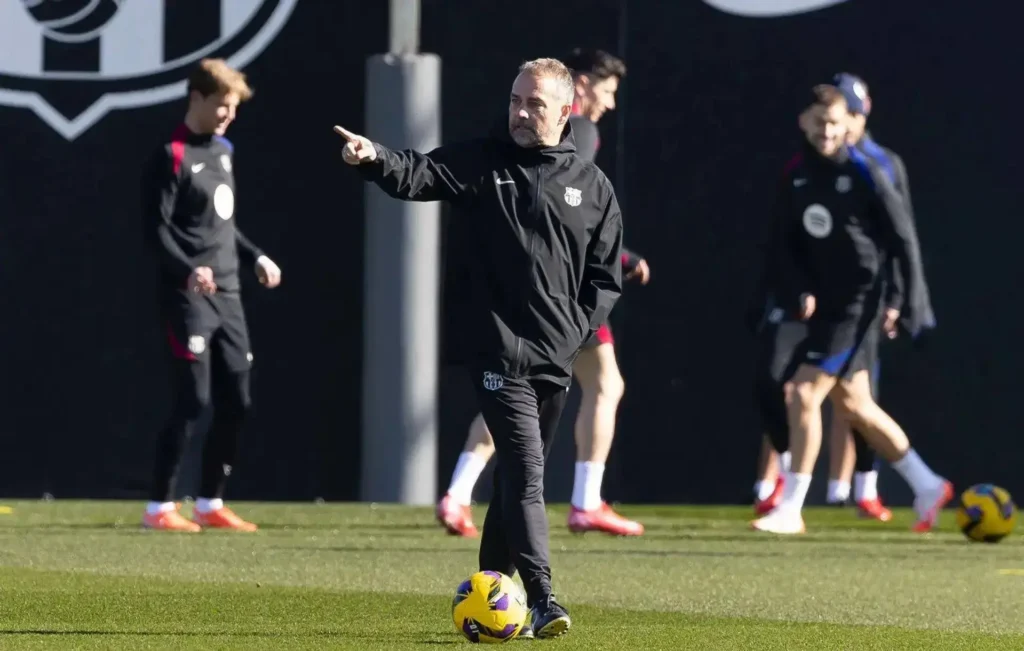
Hansi Flick at Barcelona: How His Tactics Transformed Barça
When Hansi Flick became Barcelona’s head coach, he brought more than a new name to the Camp Nou dugout.
He brought a different rhythm.
A different intensity.
A different idea of how Barcelona could attack, defend and control football.
Under Flick, Barça’s traditional possession-based identity has been combined with high-intensity pressing, fast transitions, flexible formations and aggressive attacking football. The result is a Barcelona side that can control the ball but also attack space with speed and purpose.
That tactical balance has helped Flick establish himself as one of the most successful coaches in modern Barcelona history.
By the end of the 2025/26 season, Barcelona had won LaLiga with 94 points, scored 95 league goals and won all 19 of its home league matches. Flick was also named LALIGA Coach of the Year for the second consecutive season.
But what exactly makes Hansi Flick’s Barcelona tactics so effective?
Who Is Hansi Flick?
Before arriving at Barcelona, Hansi Flick built an impressive coaching reputation in Germany.
His coaching foundation was shaped by several important experiences:
- Working as an assistant to Joachim Löw
- Coaching at Bayern Munich
- Winning the 2020 treble with Bayern
- Managing the German national team
- Developing a reputation for aggressive and direct football
His Bayern Munich success established his tactical identity.
Flick’s teams are usually associated with:
High pressing → Quick transitions → Vertical attacking → Flexible positioning
However, his Barcelona project required adaptation.
Barcelona already had a strong football identity based on possession, technical quality and positional play.
Flick did not completely abandon that identity.
Instead, he added greater intensity and verticality.
What Is Hansi Flick’s Tactical Philosophy?
The easiest way to understand Flick’s football is to think of it as controlled aggression.
His Barcelona does not want to pass the ball simply for the sake of possession.
The purpose is to use possession to create attacking opportunities.
His tactical philosophy is based on four main principles.
1. High-Intensity Pressing
When Barcelona loses the ball, the reaction is immediate.
The team attempts to win possession back quickly instead of allowing the opponent to calmly build an attack.
This requires:
- Fast reactions
- Compact positioning
- Aggressive pressure
- Coordination between attackers and midfielders
The first line of defence begins with the forwards.
That is why players such as Raphinha, Lamine Yamal and Gavi can be so important to Flick’s system.
2. Fast Transitions
One of the biggest differences between Flick’s football and slower possession-based football is the speed of the transition.
When Barcelona wins the ball, the team looks forward.
Instead of automatically recycling possession, players can immediately search for:
- Runs behind the defensive line
- One-touch combinations
- Wide attacking spaces
- Vertical passes
- Quick counter-attacks
This makes Barcelona difficult to defend.
An opponent may believe they have just lost the ball in midfield.
Seconds later, Barcelona can already be attacking the penalty area.
3. Flexible Positional Play
Flick’s Barcelona is not always rigidly tied to one position.
Players can rotate.
Wingers can move inside.
Midfielders can advance.
Full-backs can provide width.
Attackers can interchange positions.
This flexibility makes it difficult for opponents to maintain their defensive structure.
Instead of defending fixed positions, opponents must constantly react to movement.
4. A High Defensive Line
Flick’s approach also relies heavily on pushing the defensive line forward.
This helps Barcelona:
- Compress the playing area
- Keep the team closer together
- Support the pressing game
- Recover possession higher up the pitch
However, it also carries risk.
If the press is broken, the space behind the defence can become dangerous.
That risk-versus-reward balance is one of the defining features of Flick’s Barcelona.
Hansi Flick’s Barcelona Formations: 4-2-3-1 vs 4-3-3
One of the most interesting aspects of Flick’s tactics is that the formation can change depending on the match situation.
The two most important structures associated with his Barcelona are the 4-2-3-1 and 4-3-3.
The 4-2-3-1 Formation
The 4-2-3-1 gives Barcelona:
- Two midfielders providing balance
- A creative attacking midfielder
- Wide attacking options
- A central striker
This system can help Barcelona press aggressively while maintaining attacking structure.
The attacking midfielder can operate between the lines, while the wingers stretch the opposition defence.
The two deeper midfielders can provide support during transitions.
The 4-3-3 Formation
The 4-3-3 remains deeply connected to Barcelona’s football identity.
It provides:
- Three midfielders
- Two wide attackers
- One central striker
This formation allows Barcelona to control the centre of the pitch while creating width through the wings.
The structure can also change during possession.
A 4-3-3 on paper may become something completely different during the actual match.
That is the key to understanding modern football.
The formation shown before kick-off is not always the formation used during the game.
The Key Players in Hansi Flick’s Barcelona System
A tactical system is only as effective as the players executing it.
Flick’s Barcelona has a squad filled with players who bring different qualities to his football.
Lamine Yamal: The Creative Wing Weapon
Lamine Yamal gives Barcelona something special from the right side.
His ability to:
- Beat defenders
- Create chances
- Cut inside
- Carry the ball
- Deliver final passes
makes him one of the most dangerous attacking players in the team.
In Flick’s system, Yamal’s creativity can combine perfectly with the team’s direct attacking approach.
Pedri: The Midfield Controller
Pedri represents the technical intelligence of Barcelona’s midfield.
While Flick wants speed and intensity, Barcelona still needs a player capable of controlling the rhythm.
Pedri provides:
- Ball retention
- Intelligent passing
- Press resistance
- Tactical awareness
He can slow the game down when necessary and accelerate it when space appears.
Gavi: The Pressing Engine
Gavi perfectly represents the aggressive side of Flick’s football.
His energy allows him to:
- Press defenders
- Compete for second balls
- Close down opponents
- Disrupt midfield build-up
His intensity makes him particularly valuable in a high-pressing system.
Robert Lewandowski: The Clinical Focal Point
A high-intensity system still needs a reliable goalscorer.
Lewandowski provides experience and finishing ability at the top of the attack.
His role is not only to score.
He can also:
- Hold up the ball
- Link with midfielders
- Occupy central defenders
- Create space for wingers
Pau Cubarsí: The Defensive Foundation
Pau Cubarsí represents the next generation of Barcelona’s defence.
His technical quality allows him to contribute during build-up play, while his composure helps the team play from the back.
For a coach who wants to maintain a high defensive line, defenders must be comfortable defending space.
Raphinha: Intensity and Directness
Raphinha brings speed, aggression and attacking energy.
His ability to press and attack space makes him an important part of Flick’s tactical approach.
He represents the direct and intense side of Barcelona’s attacking football.
Hamza Abdelkarim: The Wildcard Attacker
One of the most exciting developments is the emergence of young Egyptian forward Hamza Abdelkarim.
His physical presence, movement and penalty-box instincts could give Flick another type of attacking option.
Unlike a traditional winger, Abdelkarim offers a different profile:
- Strong aerial ability
- Physical presence
- Back-to-goal play
- Intelligent movement
- Natural finishing instincts
This could make him an interesting wildcard within Barcelona’s attacking structure.
How Hansi Flick Changed Barcelona
Flick’s biggest impact may not be one specific formation.
It may be the change in mentality.
Barcelona under Flick plays with:
More intensity.
More directness.
More attacking risk.
More vertical movement.
The team still values possession.
But possession is no longer the final objective.
The objective is to use possession to:
- Move the opponent
- Create space
- Attack quickly
- Generate chances
- Score goals
That tactical mentality has produced significant domestic success.
Barcelona’s 2025/26 LaLiga campaign ended with 94 points and 95 goals, while the club also won every home league match.
Hansi Flick vs Guardiola: Two Different Versions of Barcelona Football
Comparisons between Hansi Flick and Pep Guardiola are inevitable.
Both coaches value:
- Technical quality
- Positional intelligence
- Ball control
- Tactical organisation
However, their approaches are different.
Guardiola’s Barcelona
Possession → Position → Control → Patience
Flick’s Barcelona
Pressing → Recovery → Verticality → Attack
This does not mean Flick’s Barcelona abandons possession football.
Instead, it adds greater urgency.
Guardiola’s Barcelona often attempted to control the game through prolonged possession.
Flick’s Barcelona is more willing to attack immediately after recovering the ball.
That difference creates a more direct and unpredictable style.
Hansi Flick vs Xavi: Why the Tactical Approach Feels Different
Xavi and Flick both understand Barcelona’s football culture.
However, their tactical approaches have important differences.
Xavi’s Barcelona was often associated with:
- Positional possession
- Structured build-up
- Control through the midfield
- Patient attacking movements
Flick’s Barcelona is more associated with:
- High pressing
- Direct attacks
- Fast transitions
- Greater verticality
- More aggressive risk-taking
The result is a team that can move from defence to attack much faster.
The Results of Flick’s Barcelona Project
The clearest evidence of a manager’s success is often found in the results.
Under Flick, Barcelona has developed into one of the most successful teams in domestic football.
In 2025/26, Barça defended its LaLiga title with 94 points and 95 goals. The club also recorded 19 wins from 19 home league matches.
Flick’s domestic success has also earned him the LALIGA Coach of the Year award for a second consecutive season.
The next major challenge is European dominance.
Barcelona’s domestic success has created a strong foundation.
The question now is whether Flick’s tactical system can take the club back to the top of European football.
What Makes Hansi Flick’s Barcelona So Dangerous?
The answer is the combination of several tactical qualities.
Barcelona can:
- Press high
- Win the ball quickly
- Attack space
- Use technical players between the lines
- Switch formations
- Create width
- Play through the centre
- Attack with speed
This tactical flexibility makes the team difficult to predict.
An opponent may prepare for a possession-based Barcelona.
Instead, they may face a team that presses aggressively and attacks vertically.
Another opponent may prepare for direct football.
Instead, Barcelona may control the game through its midfield.
That unpredictability is one of Flick’s greatest strengths.
Final Verdict: Is Hansi Flick Building a New Barcelona Era?
Hansi Flick has not attempted to copy Guardiola.
He has not attempted to completely replace Barcelona’s traditional identity.
Instead, he has created his own version of Barça football.
A version built on:
Technical quality + high pressing + vertical attacks + tactical flexibility
The results suggest that this approach is working.
Barcelona’s 2025/26 LaLiga campaign produced a second consecutive title, 94 points and 95 goals, while Flick again won the league’s Coach of the Year award.
The next chapter of the Flick era will be defined by one major question:
Can his high-intensity Barcelona become a dominant force in Europe as well as Spain?
If the answer is yes, Hansi Flick may eventually be remembered not simply as the coach who brought success back to Barcelona.
He may be remembered as the manager who created a completely new tactical identity for the modern Barça era.