
Who Are the Greatest Barcelona Midfielders of All Time?
Barcelona’s history has always run through its midfield. While strikers get the headlines and defenders get the plaudits for clean sheets, it’s the middle of the park that has defined the club’s identity for over half a century the players who controlled possession, dictated tempo, and turned Barça’s football into something the rest of the world tried and failed to copy.
That story spans several distinct eras: Johan Cruyff’s own playing days in the 1970s, the Dream Team of the early 1990s under Cruyff as coach, Frank Rijkaard’s mid-2000s revival, the Pep Guardiola era that produced the greatest midfield trio the game has seen, and the years since as the next generation has tried to fill an impossible set of boots.
Ranking Barcelona’s greatest-ever midfielders means weighing all of that history against each other — comparing a Dream Team schemer from 1992 to a tiki-taka metronome from 2011. Here’s how we approached it, and who made the final ten.
How We Ranked Barcelona’s Greatest Midfielders
Our ranking is based on a mix of:
- Individual ability and technical quality
- Barcelona appearances and longevity
- Trophies won at the club
- Influence on how the team actually played
- Big-game and final performances
- Tactical importance to their era
- Lasting legacy at Camp Nou
Raw stats matter, but they don’t tell the whole story which is why a player like Sergio Busquets, who scored just 18 goals in 722 games, still ranks above midfielders with flashier numbers.
Top 10 Barcelona Midfielders of All Time
10. Luis Suárez Miramontes
Why He Made the Top 10
Long before Xavi and Iniesta, there was “Luisito.” Luis Suárez Miramontes not to be confused with the Uruguayan striker of the same name who later played for Barça, arrived from Deportivo La Coruña in 1954 and became the creative heartbeat of a talented late-1950s Barcelona side under coach Helenio Herrera. Playing as a left-sided central midfielder, Suárez was known as “The Architect” for his passing range, game reading, and elegant technique.
In 1960 he became the first and, to date only Spanish man to win the Ballon d’Or, a reflection of just how far ahead of his era he was. Financial pressure forced Barça to sell him to Inter Milan in 1961, where he went on to win two European Cups, but his seven years in Catalonia left him as one of the most technically admired players the club has ever produced.
Barcelona Career Stats
- Appearances: 253
- Goals: 141
- Years at Barcelona: 1954–1961
- Major trophies: 2 Liga titles, 2 Spanish Cups, 2 Fairs Cups, Ballon d’Or (1960)
9. Bernd Schuster
Why He Made the Top 10
The “Blond Angel” arrived from FC Köln in 1980 and quickly became one of the most gifted playmakers in Europe a box-to-box midfielder with a ferocious long-range shot and the vision to dictate games from deep. Schuster was central to Barcelona’s Cup Winners’ Cup triumph in 1982 and their La Liga title in 1985, before a bitter falling-out with the club led to his controversial move to arch-rivals Real Madrid in 1988.
Injuries and disputes with management meant Schuster never quite fulfilled his full potential at Camp Nou, but at his best he was regarded as one of the finest midfielders on the planet, finishing runner-up for the Ballon d’Or in 1980.
Barcelona Career Stats
- Appearances: 300
- Goals: 120
- Years at Barcelona: 1980–1988
- Major trophies: 1 La Liga, 3 Copa del Rey, 1 European Cup Winners’ Cup, 2 League Cup, 1 Spanish Super Cup
8. Cesc Fàbregas
Why He Made the Top 10
A La Masia graduate who left for Arsenal as a teenager and became one of the Premier League’s best young playmakers, Fàbregas returned to Barcelona in 2011 as a homecoming signing. Though his three seasons back at Camp Nou never quite recaptured his Arsenal peak he was often used out of position on the right or as a false nine his passing range and eye for a killer ball still made him a key squad member during a trophy-laden period.
His return also symbolised something bigger: proof that La Masia’s academy graduates could go out into the world, become superstars elsewhere, and come home.
Barcelona Career Stats
- Appearances: 159
- Goals: 47
- Years at Barcelona: 2011–2014
- Major trophies: 1 La Liga, 1 Copa del Rey, 1 European Super Cup, 1 FIFA Club World Cup, 2 Spanish Super Cups
7. Ivan Rakitić
Why He Made the Top 10
Signed from Sevilla in 2014, Rakitić was written off by some as a makeweight in Barcelona’s rebuild after the end of the Xavi era until he opened the scoring in the 2015 Champions League final against Juventus, capping a historic treble in his very first season. Over six years, “Ivan the Terrible” became one of the most reliable, tactically intelligent midfielders in Europe: a player who rarely made the highlight reel but who Messi, Suárez and Busquets all leaned on heavily for balance and work rate.
Barcelona Career Stats
- Appearances: 310
- Goals: 36
- Years at Barcelona: 2014–2020
- Major trophies: 4 La Liga, 4 Copa del Rey, 1 Champions League, 1 FIFA Club World Cup, 1 UEFA Super Cup, 2 Spanish Super Cups
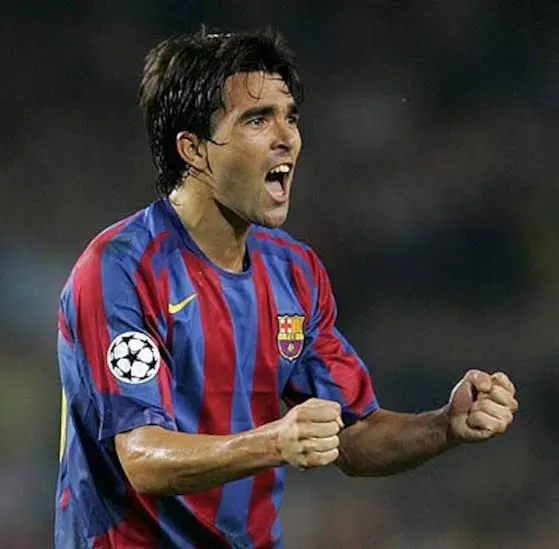
6. Deco
Why He Made the Top 10
Frank Rijkaard’s Barcelona needed a creative spark to go with Ronaldinho’s magic, and Deco signed from Porto in 2004 fresh off winning the Champions League there provided exactly that. The Brazilian-born Portuguese international was combative, technically brilliant, and unafraid of the big occasion, winning the UEFA Best Midfielder award for his role in Barça’s 2006 Champions League triumph over Arsenal.
He remains one of the few players to have won the Champions League with two different clubs, and his four years in Catalonia bridged the gap between the Rivaldo era and the emergence of a teenage Lionel Messi.
Barcelona Career Stats
- Appearances: 188
- Goals: 27
- Years at Barcelona: 2004–2008
- Major trophies: 2 La Liga, 1 Champions League, 2 Spanish Super Cups, 2 Catalonia Cups
5. Michael Laudrup
Why He Made the Top 10
If you want to know why Cruyff’s Dream Team was so revered, watch Michael Laudrup play. The Danish attacking midfielder arrived from Juventus in 1989 and immediately became the team’s creative axis a player of such effortless technique and vision that Barça fans hung a banner in the Camp Nou simply reading “Enjoy Laudrup.” He helped the club win its first-ever European Cup in 1992 and four straight La Liga titles from 1991 to 1994, before an acrimonious exit to Real Madrid ended his Barcelona career.
Barcelona Career Stats
- Appearances: 296
- Goals: 97
- Years at Barcelona: 1989–1994
- Major trophies: 4 La Liga, 1 European Cup (1992), 1 Copa del Rey
4. Pep Guardiola
Why He Made the Top 10
Before he became the most influential coach in modern football, Pep Guardiola was the deep-lying pivot who made Cruyff’s Dream Team tick. A La Masia graduate with a preternatural sense of positioning and tempo, Guardiola sat at the base of midfield and dictated the rhythm of the entire team the prototype for the “regista” role Busquets would later perfect.
He captained Barça to their historic first European Cup in 1992 and six La Liga titles across an 11-year career, before an injury-hit final season saw him leave for Italy in 2001. His deepest legacy, of course, came later: returning as coach in 2008 to build the greatest Barcelona team of all, with the very midfield trio he inspired as a player.
Barcelona Career Stats
- Appearances: 479
- Goals: 16
- Years at Barcelona: 1990–2001
- Major trophies: 6 La Liga, 1 European Cup (1992), 2 Copa del Rey, 1 Cup Winners’ Cup
3. Sergio Busquets
Why Busquets Was So Important to Barcelona
If Xavi and Iniesta were the artists, Busquets was the canvas that made their art possible. Promoted from the B team by Guardiola in 2008, Busquets redefined what a defensive midfielder could look like: rarely tackling, rarely sprinting, but rarely out of position, and always available for the ball under pressure. His reading of the game let Barça’s centre-backs push up, let the full-backs bomb forward, and let Xavi and Iniesta focus purely on creating.
Nicknamed “The Silent Wall,” Busquets was often the least talked-about member of the great Barça midfield, but Pep Guardiola himself called him one of the most tactically important players he ever coached — the player who made the whole tiki-taka machine function.
Busquets’ Barcelona Career
- Appearances: 722
- Goals: 18
- Assists: 45
- Years at Barcelona: 2008–2023
- Major trophies: 8 La Liga, 3 Champions League, 32 major trophies in total
2. Andrés Iniesta
Why Iniesta Is One of Barcelona’s Greatest Midfielders
“The Magician” was the perfect foil for Xavi’s metronomic passing a dribbler who could glide through the tightest of spaces, drag defenders out of position, and produce a moment of brilliance exactly when Barcelona needed it most. His injury-time goal against Chelsea in the 2009 Champions League semi-final sent Barça to the final in Rome; his extra-time winner in the 2010 World Cup final gave Spain their first-ever world title.
Iniesta’s Barcelona career ran for 16 first-team seasons, during which he won nine La Liga titles and four Champions Leagues, becoming alongside Xavi one of the two players most synonymous with Barcelona’s golden era.
Iniesta’s Barcelona Career
- Appearances: 674
- Goals: 57
- Assists: 139
- Years at Barcelona: 2002–2018
- Major trophies: 9 La Liga, 4 Champions League, 32 trophies in total
1. Xavi Hernández
Why Xavi Is the Greatest Barcelona Midfielder
No player embodies Barcelona’s footballing philosophy more completely than Xavi Hernández. Across 17 seasons in the first team, Xavi barely gave the ball away, constantly found space between the lines, and set the tempo of virtually every match he played — a level of control that led Sir Alex Ferguson to remark that he had “never seen Xavi and Iniesta give the ball away in their lives.”
Xavi’s numbers back up the reputation: he holds the club’s all-time appearance record among outfield legends of his era, was named Best Midfielder in La Liga three years running (2009, 2010, 2011), and was named Player of the Tournament at Euro 2008. His influence on Barça’s tiki-taka identity — and, by extension, on the way modern football is coached and played — is difficult to overstate.
Xavi’s Barcelona Career
- Appearances: 767
- Goals: 85
- Assists: 184
- Years at Barcelona: 1998–2015
- Major trophies: 8 La Liga, 4 Champions League, 25 trophies in total
Xavi vs Iniesta vs Busquets: Who Was the Best?
This is where the debate really lives and there’s no single right answer, because the three didn’t compete with each other so much as complete each other.
Xavi – The Best for Passing and Game Control
Nobody in Barcelona’s history controlled a match through passing the way Xavi did. His short, quick combinations set the rhythm that every other player — Messi included — built their game around.
Iniesta – The Best for Creativity and Big Moments
Iniesta had the dribbling and the individual brilliance to break down a defence when patient passing alone couldn’t. He was the player Barça turned to when a game needed a moment of magic, not just possession.
Busquets – The Best for Defensive Intelligence
Busquets never got the same adulation, but without his positioning and press resistance in front of the back four, neither Xavi nor Iniesta would have had the freedom to do what they did.
Who Had the Biggest Impact on Barcelona?
If forced to pick one, most judges lean toward Xavi his influence stretched furthest, from his debut in 1998 through the club’s greatest years to his eventual return as head coach. But it’s genuinely close between him and Iniesta, and that closeness is exactly what made this midfield trio so devastating: it was never a one-man show.
Barcelona’s Greatest Midfield Trio: Xavi, Iniesta and Busquets
How Xavi, Iniesta and Busquets Complemented Each Other
Busquets shielded the defence and recycled possession under pressure. Xavi received the ball from him and dictated tempo with short, precise passing. Iniesta occupied the space between the lines, using his dribbling to unlock defences that couldn’t be broken down by passing alone. Together, they gave Barcelona control of matches from the first minute to the last.
Their Role in Barcelona’s Tiki-Taka
Under Pep Guardiola, this trio became the engine of tiki-taka a style built on relentless short passing, constant movement and suffocating pressure the moment the ball was lost. It wasn’t just effective; it changed how coaches around the world thought about possession football.
Trophies Won Together
Between 2008 and 2015, the trio shared multiple La Liga titles and three Champions League triumphs, forming the spine of two treble-winning sides (2009 and 2015).
Why Their Midfield Changed Modern Football
The Xavi-Iniesta-Busquets axis didn’t just win trophies it influenced Spain’s World Cup and European Championship wins between 2008 and 2012, and it became the template that a generation of coaches, from Guardiola himself to his disciples, tried to replicate at other clubs.
Other Barcelona Midfield Legends Who Deserve a Mention
Ten spots can’t cover everyone. A few other names regularly come up in these debates:
- Josep Samitier – A 1920s icon often credited as one of the first true box-to-box midfielders in Barça’s history, known as much for his goalscoring as his all-round play.
- Frank Rijkaard – Though best remembered at Barcelona as the coach who rebuilt the club from 2003 to 2008 (and won the 2006 Champions League), Rijkaard’s own playing career belonged to Ajax and AC Milan rather than Barça.
- Rivaldo – Often deployed centrally or off the left, his individual brilliance in the late 1990s and early 2000s puts him in these conversations even though he’s more commonly remembered as a forward.
- Luis Enrique – A tireless box-to-box presence in the 1990s before becoming a hugely successful Barça coach himself.
- Carles Rexach – A key creative figure in the 1970s squad that included Johan Cruyff.
- Ronald Koeman – Primarily a sweeper/defender, but his deep-lying passing range made him a quasi-midfield presence in the Dream Team.
Barcelona Midfielders by Era
Barcelona Midfielders of the 1950s–1970s
Luis Suárez Miramontes and Josep Samitier defined this period, laying the technical foundations Barça would later build on.
Barcelona Midfielders of the Dream Team Era (1988–1996)
Pep Guardiola, Michael Laudrup and Bernd Schuster (in the years just before Cruyff’s arrival as coach) gave Barça a technically dominant midfield that won the club’s first European Cup.
Barcelona Midfielders of the 2000s
Deco and a young Xavi bridged the gap between the post-Cruyff years and the Guardiola revolution.
Barcelona Midfielders of the Guardiola Era (2008–2012)
Xavi, Iniesta and Busquets formed arguably the greatest midfield trio in football history.
Barcelona Midfielders of the Post-Xavi/Iniesta Era
Ivan Rakitić and Cesc Fàbregas helped carry the torch through a period of transition, while Busquets remained the last man standing from the golden generation until his exit in 2023.
Frequently Asked Questions
Who is the greatest Barcelona midfielder of all time?
Xavi Hernández is widely considered the greatest Barcelona midfielder of all time. His 17-year career, unmatched passing control and central role in the club’s most successful era put him at the top of most rankings, narrowly ahead of Andrés Iniesta.
Who are the top 3 Barcelona midfielders of all time?
Most rankings, including this one, place Xavi Hernández first, Andrés Iniesta second, and Sergio Busquets third the three players who formed Barcelona’s legendary midfield trio under Pep Guardiola.
Is Xavi better than Iniesta?
It’s close. Xavi controlled games through passing and tempo, while Iniesta offered more individual creativity and match-winning moments. Xavi generally edges the debate for his longer career, greater trophy haul and deeper influence on the club’s playing style, but many fans and pundits prefer Iniesta’s flair.
Is Busquets one of Barcelona’s greatest midfielders?
Yes. Despite modest goal and assist numbers, Busquets’ positional intelligence and press resistance were essential to Barcelona’s tiki-taka system. Pep Guardiola himself has called him one of the most important players of that era.
Who was Barcelona’s best midfield trio?
Xavi, Iniesta and Busquets, without much debate. Together they won multiple La Liga titles and three Champions League trophies, and formed the backbone of two treble-winning squads.
Who is Barcelona’s most successful midfielder?
By major trophies won at the club, Iniesta and Busquets are tied at 32 each, just ahead of Xavi’s 25. By influence and individual reputation, Xavi is usually still ranked first.
Final Ranking
| Rank | Player |
| 1 | Xavi Hernández |
| 2 | Andrés Iniesta |
| 3 | Sergio Busquets |
| 4 | Pep Guardiola |
| 5 | Michael Laudrup |
| 6 | Deco |
| 7 | Ivan Rakitić |
| 8 | Cesc Fàbregas |
| 9 | Bernd Schuster |
| 10 | Luis Suárez Miramontes |